
He has long wanted to realise a breast augmentation and feel that now is the time? Undergoing a breast augmentation is undoubtedly a very important decision in a woman's life, which is why it needs to be well thought out and considered.
So we share a list of 10 important points that you should know before having surgery and that can help you make a more informed decision.
1. type of breast implants
Because no two women's physical structures are the same and because they don't all want the same result, the different ranges of breast implants make it possible to adapting the choice of implants to the results each woman wants to achieve.
There is a wide variety of breast implants in different shapes, sizes, projections, coatings and weights:
• Formatround and drop
• Sizedifferent sizes, from 55 to 1000 cc's
• Projectionlow, moderate, high and extra high profile
• Coatingsmooth, textured, micro-textured and polyurethane-coated surface
• WeightB-lite implants are 30% lighter than conventional implants, offering advantages in a number of situations
2. There is no Ideal Breast Implant Size
The most commonly used implant sizes ranging from 250 to 400 cc. However, there is no ideal size that suits all women. For example, 350 cc implants can look large on a slim patient with a narrow chest, while the same size can look small on a tall patient with a large frame.
At the initial medical consultation, your plastic surgeon will advise you on the size of the implants ideal for your specific case, in order to achieve a harmonious, proportionate result that meets your objectives.
There will also be a 3D simulation with different implants so that you can get an idea of the results that can be achieved.


3. Breast Augmentation Scars
Any surgical intervention is associated with permanent scars. However, with the passage of time, they tend to become more final and less visible. The final appearance of the scars depends above all on the genetic characteristics of each patient and the care taken in the post-operative period. The 2 most common types of scars in breast augmentation stand out:
• Infra-mammary scarThis is the most common type of scar and is hidden in the natural fold of the breast, so it is not visible to the naked eye. This type of incision allows the plastic surgeon excellent visualisation of the operated area, with direct access to the place where the breast implant will be placed. It is the most suitable scar for women who wish to breastfeed in the future as it does not affect the mammary gland or the ducts responsible for transporting milk to the outside of the breast.

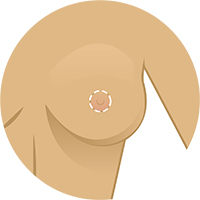
• Periareolar scarThis is done in the lower area of the areola, at the transition from the areolar tissue to the skin of the breast. This is one of the areas where the scar is most concealed, due to the natural colour transition in this area. This approach is often used when a woman has slightly sagging breasts, but not enough to perform a breast lift. It is also common in cases of correction of small breast asymmetries and also in cases of tuberous breast correction where it is necessary to reduce the size of the areola.
4) Anaesthesia
Breast Augmentation is usually performed under sedation and local anaesthesia. This means that local anaesthetics are injected into the area to be operated on, and the patient will be sound asleep and breathing on her own. After the surgery, you will be under observation for a few hours until you are discharged.
5. Breastfeeding after Breast Augmentation
Breastfeeding is one of the main concerns for women who want to get pregnant after having a breast augmentation.
Interference with breastfeeding is a possible risk of breast augmentation, but most women are able to breastfeed their babies after surgery. There are surgical techniques that, when performed properly, reduce the risk of interfering with breastfeeding.
For example, opting for an inframammary incision presents less risk for future breastfeeding, as it doesn't interfere with the ducts responsible for passing milk to the outside of the breast.
If you haven't been a mum yet or if you want to get pregnant and breastfeed again, you should discuss this with your plastic surgeon so that the most appropriate techniques can be chosen to preserve the integrity of the areola and breast ducts.

6. Breast implants are not lifelong
Breast implants are extremely resistant. However, a woman wishing to have a breast augmentation should be aware that there are no lifetime implants and that she may need a revision/implant exchange surgery after a few years - on average, 10 to 15 years later.
In addition, no surgery guarantees lifelong results or stops the changes that occur in the appearance of the breast due to the natural process of ageing, weight fluctuations, pregnancy and breastfeeding.
7. In addition to augmentation, you may need a breast lift
If breast sagging is very slight, it may be possible to achieve a good breast augmentation result with breast implants alone. On the other hand, in cases of more pronounced breast sagging, it may be more appropriate to carry out a breast augmentation. Mastopexy with implants (breast lift). There are various degrees of breast sagging, related to the position of the nipple and the distribution and position of the mammary gland. These aspects are assessed at the initial medical consultation in order to decide on the most suitable technique for your case.

Learn more about Mastopexy with Implants
8. Rapid recovery from breast augmentation
At our clinic we use the Rapid Recovery in breast augmentation for over 10 years, with experience and results proven by the low percentage of complications. The aim is for your recovery to be as comfortable and fast as possible, but always prioritising safety.
Most women go through the surgery extremely comfortably, but it is still necessary to allow time to recover calmly, so as not to precipitate avoidable complications. However, each case is different. On average, after 1 week's rest, In the meantime, he will be able to return to work and daily activities that do not involve physical exertion. After 4 weeks, If there are no contraindications from your doctor, you can resume all your activities.

9. Breast Augmentation Price
One of the most frequently asked questions by women who want to have breast augmentation surgery is “How much does a breast augmentation cost?”. The price of breast augmentation is, on average, from €4,750.
However, there are several factors that can influence the final price of breast augmentation such as the type of implants chosen and the techniques applied. For example, if a woman has slightly sagging breasts, it may be necessary to remove some of the skin around the areola.
In addition, when assessing the final price of the surgery, you should consider everything that is and isn't included in the final price: operating theatre, medical and nursing staff, anaesthesia, breast implants, surgical bra, post-operative medication, lymphatic drainage and follow-up appointments.

10. The result you see on the first day is not the final result
Due to post-operative oedema, the breast may appear larger, swollen and higher than desired. Over time, as the post-operative oedema decreases, the result will look increasingly beautiful and natural.
The result of breast augmentation progressively improves up to 12 months, This is when the final result of the surgery is obtained. In the gallery on our website, you can see several examples of before and after breast augmentation.
At LMR, we prioritise your well-being, guaranteeing personalised care and natural results.
If you want to have your plastic surgery safely and with quality follow-up, book your appointment with one of our doctors specialising in Plastic, Reconstructive and Aesthetic Surgery.